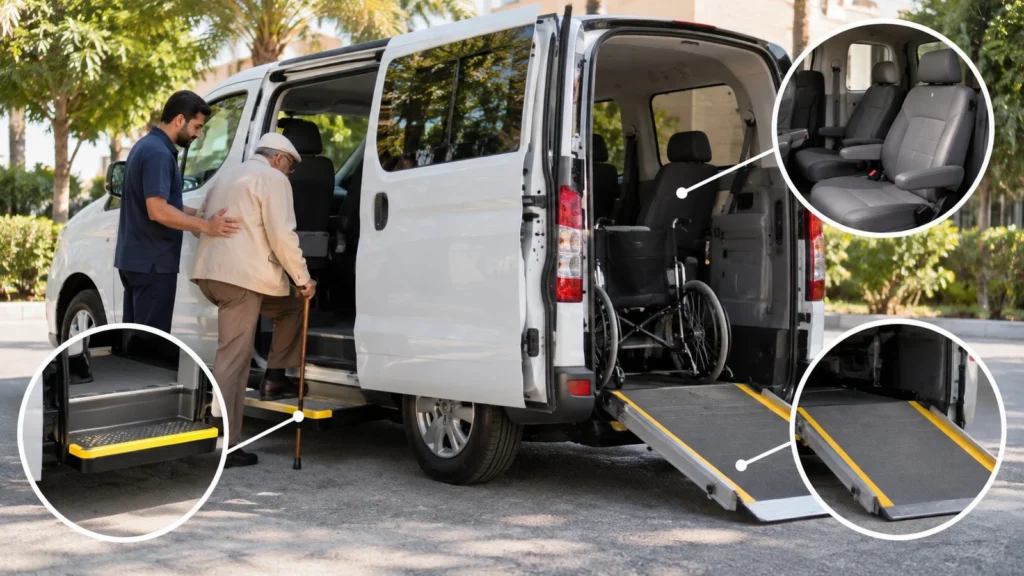
Choosing a suitable vehicle for elderly passengers requires evaluating their mobility, boarding ability, seating needs, and travel safety. The right vehicle should allow the passenger to enter, sit, travel, and exit comfortably while accommodating any walking aids or wheelchair equipment they use.
The seven essential factors when choosing a vehicle for elderly passengers are mobility and transfer ability, vehicle entry accessibility, seat comfort, wheelchair compatibility, interior space, passenger safety, and boarding assistance.
The seven factors to consider when choosing a suitable vehicle for elderly passengers are explained below.
- Passenger mobility and transfer ability
The passenger’s mobility determines the type of vehicle they can use. Elderly passengers who walk independently may travel in standard vehicles, while those who use wheelchairs or have difficulty transferring to a seat may require specialized accessibility arrangements.
Assess whether the passenger can walk, manage vehicle steps, and sit down without unsafe physical effort. - Vehicle entry height and door accessibility
Vehicle entry height and doorway clearance affect how easily elderly passengers can enter and exit. High steps, narrow openings, or limited handholds may make boarding difficult for passengers with reduced mobility.
Choose a vehicle with an accessible entrance, manageable step height, and sufficient doorway space for the passenger’s needs. - Seat height, support, and comfort
Suitable seating helps elderly passengers sit down, remain supported, and stand up when leaving the vehicle. Seat height, back support, legroom, and seat-belt positioning are important considerations.
Passengers who experience joint stiffness or difficulty bending their knees may need seats that do not require excessive lowering or lifting of the body. - Wheelchair and mobility equipment compatibility
The vehicle must accommodate any wheelchair, walker, or other mobility equipment used by the passenger. Compatibility depends on equipment dimensions, available storage space, and whether the passenger transfers to a vehicle seat.
Passengers who remain seated in wheelchairs require suitable boarding equipment, designated wheelchair spaces, and compatible securement systems. - Interior space and passenger positioning
Interior space affects seating comfort, passenger movement, and the positioning of mobility equipment. Adequate headroom, legroom, and unobstructed access are particularly important for elderly passengers with limited flexibility.
For wheelchair users, the interior layout must also provide sufficient clearance for positioning and securing the wheelchair. - Passenger safety and restraint systems
Passenger safety equipment should match the seating arrangement. Elderly passengers using vehicle seats need properly fitted seat belts, while passengers remaining in wheelchairs require compatible wheelchair securement and occupant restraint systems.
Confirm that the passenger can use the available restraints correctly and that the vehicle supports their intended travel position. - Boarding assistance and vehicle accessibility features
Some elderly passengers need additional support when entering or exiting a vehicle. Depending on their mobility requirements, suitable features may include support handrails, wheelchair ramps, or powered lifts.
Select a vehicle whose accessibility equipment accommodates the passenger’s mobility needs and allows boarding and exiting without unsafe manual lifting.
Which vehicle type is suitable for different elderly passengers?
The suitable vehicle type depends on whether the elderly passenger walks independently, uses mobility equipment, transfers from a wheelchair, or requires medical supervision. Different mobility conditions require different vehicle entry, seating, accessibility, and safety arrangements.
The common elderly passenger requirements and corresponding vehicle characteristics are compared below.
| Elderly passenger requirements | Suitable vehicle characteristics |
| Walks independently | Manageable entry height, comfortable seating, sufficient legroom, and appropriate seat belts |
| Uses a cane or walker | Accessible doorway, support handholds, manageable steps, and storage for mobility equipment |
| Uses a wheelchair but can transfer | Suitable passenger seating, accessible transfer arrangements, and secure wheelchair storage |
| Remains seated in a wheelchair | Wheelchair-accessible vehicle with a compatible ramp or lift, designated wheelchair space, securement equipment, and occupant restraints |
| Requires medical monitoring during travel | Medically appropriate transportation with the necessary clinical personnel and equipment, potentially including an ambulance |
The final vehicle choice should reflect the passenger’s actual mobility and medical requirements rather than age alone.
Can elderly passengers who use wheelchairs travel in a standard vehicle?
Yes, elderly passengers who use wheelchairs can travel in a standard vehicle if they can transfer safely into a passenger seat and their wheelchair can be stored securely. Passengers who must remain seated in their wheelchairs generally need an appropriately equipped accessible vehicle. Families comparing these arrangements can review the features and equipment of wheelchair-accessible transport vehicles to understand boarding systems, designated wheelchair spaces, and securement requirements.
Should families check vehicle suitability before booking wheelchair transportation in Kuwait?
Yes, families should check vehicle suitability before booking wheelchair transportation in Kuwait to confirm that the vehicle accommodates the passenger’s wheelchair dimensions, mobility limitations, and boarding needs. Once the necessary vehicle characteristics are identified, families can learn how to book a wheelchair transport vehicle in Kuwait by confirming equipment compatibility, boarding assistance, and journey arrangements.
Do elderly passengers need to prepare mobility information before a scheduled journey?
Yes, elderly passengers should prepare relevant mobility information before a scheduled journey, including walking ability, wheelchair dimensions, transfer requirements, and assistance needs. For passengers who use wheelchairs, a checklist for a wheelchair user’s journey can help organize accessibility details and verify vehicle compatibility before departure